
Ultrasound-Guided Joint Injections in Dorchester: Why Precision Matters

Updated: Apr 4
If you are suffering from persistent joint pain in your shoulder, knee, or hip, a steroid injection is often the "gold standard" for rapid relief. However, not all injections are performed equally.
Historically, doctors used the landmark-guided method (often called "blind" injections), relying on touch and anatomical knowledge to guess where the needle should go. Today, ultrasound-guided injections have revolutionised this process, allowing your Private GP to see exactly where the needle is in real-time.
At our practice in Poundbury, Dorchester, we prioritise precision. This guide explains why ultrasound guidance isn't just a luxury; it is a medical necessity for safety, accuracy, and better pain relief.
What is the Difference? (The Bottom Line)
For patients seeking immediate clarity, here is the core difference:
Landmark-Guided (Blind) Injections: The doctor feels for bony landmarks (like the edge of a shoulder blade or kneecap) to estimate the injection site. Studies show this method can miss the target joint space up to 20-30% of the time.
Ultrasound-Guided Injections: The doctor uses a high-resolution scanner to visualize the joint, the fluid, and the needle tip in real-time. This ensures the medication is delivered exactly where inflammation is highest, with accuracy rates often exceeding 95-98%.
Medical Review: "Think of it like driving in the dark versus driving with headlights. Ultrasound allows us to see the 'road'—the nerves, blood vessels, and the exact joint space; ensuring we reach the destination safely."

The 4 Key Benefits of Ultrasound-Guided Injections
Research published in the BMJ and The Lancet consistently highlights four major advantages of using imaging guidance over the traditional "blind" approach.
1. Superior Accuracy (The Stats Don't Lie)
The most compelling argument for ultrasound is pure data. When a needle misses the joint space, the steroid is injected into surrounding fat or muscle, rendering it far less effective.
Knee Injections: Ultrasound guidance achieves 98% accuracy, compared to roughly 80% for blind injections.
Shoulder (AC Joint): Blind injections miss the joint nearly 32% of the time. Ultrasound guidance reduces this error rate to less than 7%.
2. Reduced Procedural Pain
Many patients fear that "more technology" means "more pain." The opposite is true. Because we can see the needle, we avoid hitting sensitive structures like the periosteum (bone surface) or nerves. We can also navigate around painful spurs or tight spots, making the injection smoother and more comfortable.
3. Diagnostic "Bonus"
When you visit us in West Dorset for an injection, you are also getting a mini-scan. Before we inject, we look at the joint. We often find:
Excess fluid (effusion) that needs draining.
Tendon tears that were not felt by physical exam.
Inflammation in a bursa (bursitis). This "look before you leap" approach ensures we are treating the right problem.
4. Safety and Risk Reduction
The anatomy of the hip and shoulder is complex, with major arteries and nerves running close to injection sites. Ultrasound allows us to visualize these hazards and guide the needle safely past them, significantly lowering the risk of neurovascular injury.
Joint-Specific Breakdown: Why It Matters for You
The Shoulder (Rotator Cuff & Frozen Shoulder)
The shoulder is a crowded intersection of tendons and bone. A "blind" injection into the subacromial space often accidentally hits the rotator cuff tendon itself, which can weaken the tissue.
Our Approach: We visualise the bursa (a fluid-filled sack) and watch the fluid expand it on the screen. This confirms the medication is bathing the inflamed tissue, not damaging the tendon.
The Knee (Osteoarthritis)
While the knee seems large and easy to inject, blind injections frequently land in the fat pad, which can be painful and ineffective.
Our Approach: We use ultrasound to identify the "suprapatellar pouch" (the largest space in the knee) to ensure the steroid disperses throughout the whole joint for maximum relief.
The Hip
We never recommend blind injections for the hip due to the depth of the joint and the proximity of the femoral nerve.
Our Approach: Ultrasound allows us to navigate deep into the trochanteric bursa in bursitis.
Why Choose a Private GP in Dorchester?
The NHS provides exceptional care, but waiting lists for specialist ultrasound-guided injections can currently range from 20 to 36 weeks in the Dorset area.
By choosing a Private GP in Poundbury, you benefit from:
Speed: Appointments often available within 48 hours.
Continuity: The same doctor diagnoses you, scans you, and treats you.
Convenience: Located in the accessible Hamslade Green area of Poundbury, with easy parking and a calm environment.
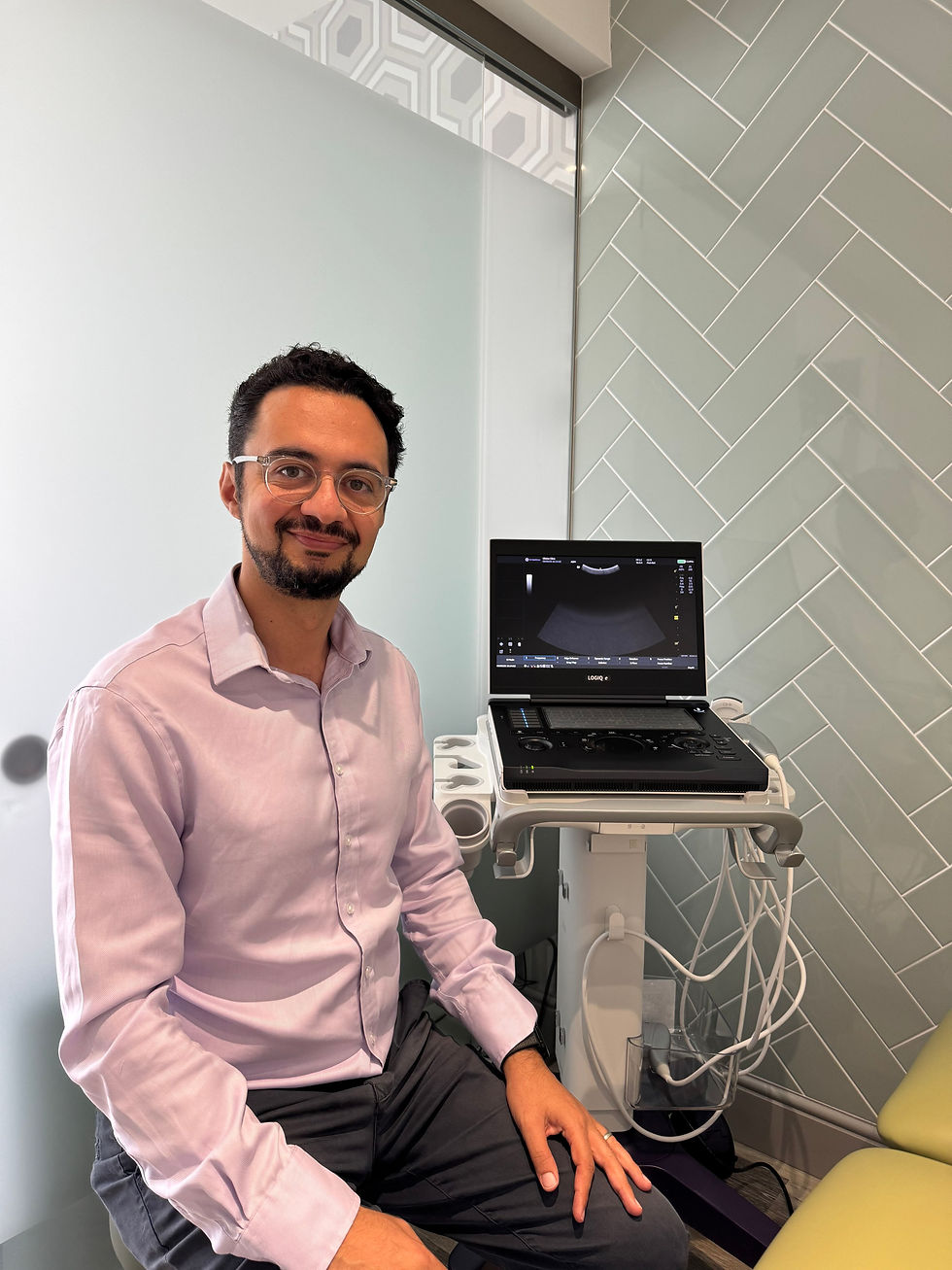
Technology: We use state-of-the-art portable ultrasound scanners for crystal-clear imaging.
What to Expect During Your Appointment
If you are nervous about needles, knowing the process helps. Here is a step-by-step of a typical visit at our Dorchester clinic:
The Scan: We apply cool gel and use the probe to map out your joint. You can watch on the screen if you wish.
The Plan: We mark the exact entry point on your skin.
The Clean: We use a sterile technique to clean the skin thoroughly.
The Injection: You may feel a scratch and some pressure. We watch the screen to ensure the needle tip is in the perfect spot before releasing the medication.
The Recovery: You stay with us for 15 minutes to ensure you feel well, then you are free to go home.
Frequently Asked Questions
Is an ultrasound-guided injection more painful?
No. Studies indicate that ultrasound-guided injections are often less painful than blind injections because the doctor can avoid sensitive structures like nerves and bone, and one precise attempt is usually sufficient.
How much more accurate is an ultrasound-guided injection?
On average, ultrasound-guided injections are 95-100% accurate, whereas blind (landmark-guided) injections vary from 60-80% accuracy depending on the joint and the patient's anatomy.
Can I drive after a joint injection?
We generally advise against driving immediately after the procedure, especially for right-sided knee/hip or shoulder injections, as the local anaesthetic can temporarily affect your control. Please arrange a lift from Poundbury.
Medical Disclaimer
The content provided here is for informational purposes only and is not a substitute for professional medical advice. All medical procedures carry risks. Please consult with your GP or a specialist to discuss if an ultrasound-guided injection is right for you.
Ready to live pain-free?
Don't let joint pain dictate your life. [Book a Consultation] with our Private GP team in Dorchester today to discuss if an ultrasound-guided injection is the right solution for you. Read more about our Joint Injections services here.
Author: Dr Mehrdad Bordbar BMBS MMedSc MRCGP - Private GP and Clinical Director at Olivine Clinic Poundbury - GMC 7456052


Comments