
Advanced Ultrasound-Guided Joint Injections in Dorchester: A One-Stop MSK Clinic for Precision Pain Relief

Author: Dr Mehrdad Bordbar BMBS MMedSc MRCGP AFMCP
Location: Olivine Clinic, 5 Hamslade Green, Poundbury, Dorchester, DT1 3DP
Last Medically Reviewed: 12 May 2026
The Bottom Line: If you are suffering from persistent shoulder or knee pain, an accurate diagnosis and targeted treatment are essential. At the Olivine Clinic in Poundbury, Dorchester, we offer a dedicated "One-Stop" Musculoskeletal (MSK) Clinic. This premium, one-hour appointment provides a comprehensive clinical assessment, diagnostic Point of Care Ultrasound (POCUS), a customised rehabilitation plan, and—if appropriate—a highly precise ultrasound-guided joint injection to relieve pain and restore mobility.
What is Point of Care Ultrasound (POCUS) in MSK Medicine?

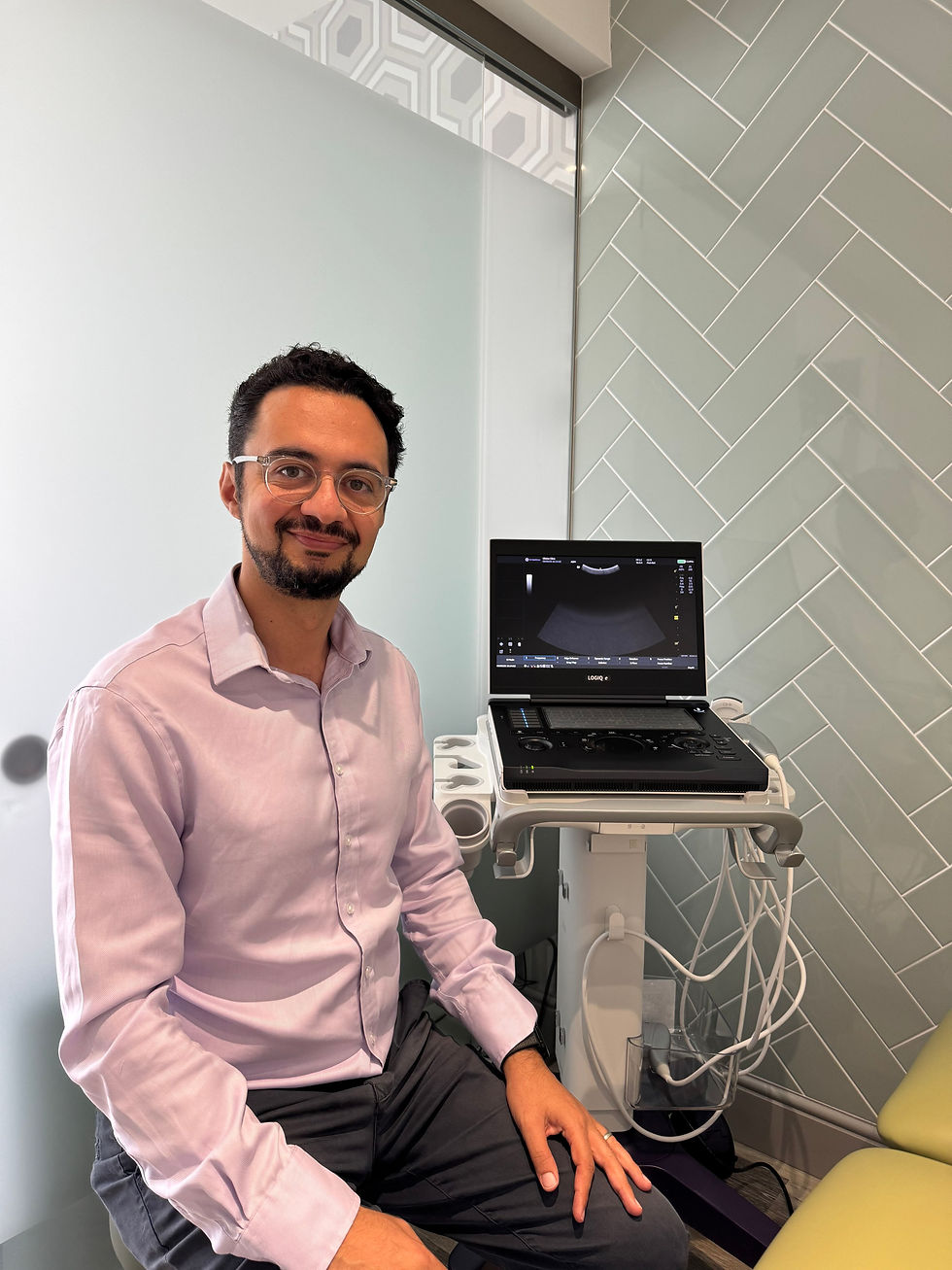
Point of Care Ultrasound (POCUS) refers to the use of highly advanced, portable ultrasound technology by a clinician directly at the patient's bedside or during a consultation.
Unlike traditional pathways—where a GP refers you to a hospital for a scan, followed by a weeks-long wait for results, and a subsequent wait for treatment—POCUS allows for immediate, dynamic visualisation of your joints, tendons, and ligaments in real time.
In the context of musculoskeletal (MSK) medicine, ultrasound is invaluable. It utilises high-frequency sound waves to create high-resolution images of your soft tissues. This allows us to instantly identify issues such as inflammation, tears, fluid build-up, or structural impingements that might be causing your pain. By incorporating POCUS into our Dorchester practice, we bypass prolonged waiting times, providing you with clarity and actionable treatment options in a single visit.
Investing in Excellence: Bringing Gold-Standard Diagnostics to West Dorset
As a Private GP, my core philosophy is to provide proactive, precision-based medicine. Patient safety, clinical excellence, and optimal outcomes remain at the forefront of my practice. To ensure my patients in West Dorset have access to the highest tier of MSK care, I have heavily invested in expanding my diagnostic and interventional capabilities.
Recently, I completed two highly intensive, advanced training courses with the prestigious Sports Medicine Ultrasound Group (SMUG) (ultrasoundtraining.co.uk):
April 2026: Introduction to Musculoskeletal (MSK) Ultrasound.
May 2026: Cadaveric Ultrasound-Guided MSK Injections (Upper and Lower Limb).
These rigorous courses are officially accredited by the European Society of Musculoskeletal Radiology (ESSR), the Royal College of Radiologists (RCR), and the Faculty of Sport and Exercise Medicine UK (FSEM UK).
Training on cadaveric specimens under the supervision of leading MSK radiologists and orthopaedic specialists provides an unparalleled level of anatomical familiarity and procedural precision. This investment in continuous professional development (CPD) means that the Olivine Clinic can now offer hospital-grade interventional techniques directly within the comforting, unhurried environment of our Poundbury surgery.
Why Choose Ultrasound-Guided Injections Over "Blind" Injections?

For decades, joint and soft tissue injections were performed "blindly" (also known as landmark-guided injections). In these procedures, the doctor relies solely on anatomical knowledge and palpating (feeling) the bones to guide the needle into the joint space.
While landmark-guided injections can be effective, they carry an inherent margin of error. Peer-reviewed research—including literature supported by the British Medical Journal (BMJ)—demonstrates that ultrasound-guided injections are significantly more precise and effective than unguided injections.
The Evidence-Based Advantages of Ultrasound Guidance:
Pinpoint Accuracy: Studies suggest that the accuracy of blind injections can range anywhere from 60% to 80% depending on the joint. Ultrasound guidance elevates this accuracy to over 95%. I can visualise the needle tip in real-time, ensuring the medication is deposited exactly into the affected joint capsule, bursa, or tendon sheath.
Enhanced Efficacy: Because the medication reaches the precise site of inflammation or damage, patients generally experience faster and more profound pain relief.
Improved Patient Safety: Visualising the internal anatomy allows me to easily navigate around crucial nerves, blood vessels, and healthy tissue. This drastically reduces the risk of accidental tissue damage and minimises potential side effects.
Reduced Discomfort: A more direct, accurate needle pathway means less probing and repositioning, resulting in a significantly more comfortable experience for the patient.
This evidence-backed superiority is exactly why I have chosen to adopt the ultrasound-guided approach as the gold standard for my patients at the Olivine Clinic.
The Olivine Clinic "One-Stop" 1-Hour Assessment Model

The traditional healthcare model often fragments patient care. You might see a doctor for 10 minutes, a sonographer a month later, and a physiotherapist after that.
At the Olivine Clinic, we recognise that treating chronic pain requires time, deep analysis, and a holistic approach. Therefore, we have designed the 1-Hour "One-Stop" MSK Clinic.
During this comprehensive 60-minute appointment, we cover all necessary ground:
In-Depth Clinical History: We discuss the nature of your pain, how it impacts your daily life, your medical history, and your health goals.
Physical Examination: A thorough orthopaedic assessment of the affected joint to check mobility, strength, and signs of structural damage.
Diagnostic Ultrasound (POCUS): We scan the joint together in real-time, allowing me to show you exactly what is happening inside your knee or shoulder.
Collaborative Management Plan: We discuss all viable treatment options, guided by the latest National Institute for Health and Care Excellence (NICE) guidelines.
Rehabilitation Advice: Injections are most effective when paired with movement. I will provide targeted rehabilitation exercises and lifestyle advice to strengthen the supporting musculature.
Precision Injection (If Indicated): If we agree that an injection is the best course of action, it will be administered safely and accurately under ultrasound guidance during the same appointment.
This model respects your time, drastically reduces your pain burden quickly, and provides a clear roadmap for your recovery.
Key Conditions Treated with Ultrasound-Guided Injections
At present, my advanced MSK interventions focus on the major joints of the upper and lower limbs—specifically the knee and the shoulder. These are complex joints that bear significant load and are highly susceptible to wear, tear, and inflammatory conditions.
1. Knee and Shoulder Osteoarthritis (OA)
Osteoarthritis is the most common form of joint disease in the UK. It occurs when the protective cartilage that cushions the ends of your bones degenerates over time. This leads to pain, swelling, and stiffness, severely limiting your mobility and quality of life.
NICE Guidelines Context: NICE guidelines for osteoarthritis (www.nice.org.uk/guidance/cg177) recommend core treatments such as weight management, therapeutic exercise, and topical pain relief. However, when these conservative measures fail to provide adequate relief, intra-articular (joint) injections act as a powerful adjunct to help patients engage in their rehabilitation programmes.
How We Treat It: Using ultrasound, we can safely enter the compromised joint space of the osteoarthritic knee or shoulder, delivering targeted anti-inflammatory medication or joint lubricants to drastically reduce pain and improve mechanical function.
2. Shoulder Impingement Syndrome (Subacromial Pain Syndrome)
Shoulder impingement occurs when the tendons of the rotator cuff become trapped, pinched, or irritated as they pass through the narrow bony space (the subacromial space) at the top of the shoulder. This causes sharp pain, especially when lifting the arm overhead or reaching backwards.
How We Treat It: An ultrasound scan can quickly confirm the presence of fluid (bursitis) or tendon thickening (tendinopathy) in the subacromial space. Under ultrasound guidance, we can precisely inject an anti-inflammatory medication directly into the swollen bursa, shrinking the inflamed tissue and immediately relieving the "pinching" sensation.
3. Frozen Shoulder (Adhesive Capsulitis)
A frozen shoulder is a profoundly painful and debilitating condition characterised by severe stiffness and a drastic reduction in the shoulder's range of motion. It occurs when the flexible tissue surrounding the shoulder joint (the capsule) becomes inflamed, thickened, and contracted.
How We Treat It: Treating frozen shoulder often depends on the stage of the condition. During the early, highly painful "freezing" phase, an ultrasound-guided corticosteroid injection directed precisely into the glenohumeral joint capsule can rapidly halt the inflammatory cascade, providing immense pain relief and preventing further stiffening.
Customised Care: Tailoring the Right Injectable for You
There is no "one-size-fits-all" approach to medicine. The type of medication we use during your procedure will be tailored specifically to your exact diagnosis, the chronicity of your symptoms, and the root cause of your pain. We primarily utilise two types of injectable treatments:
Corticosteroid Injections (Cortisone)
Corticosteroids are powerful, synthetic versions of the hormones naturally produced by your adrenal glands.
Mechanism of Action: They act as highly potent, localised anti-inflammatories. When injected directly into an inflamed joint, bursa, or tendon sheath, they rapidly calm the immune response, reducing swelling, heat, and pain.
Best For: Acute inflammatory conditions, acute flare-ups of osteoarthritis, shoulder impingement, and the early stages of frozen shoulder.
Duration: Relief can last anywhere from a few weeks to several months, providing a vital "window of opportunity" for patients to engage in physiotherapy pain-free.
Hyaluronic Acid (HA) Injections (Viscosupplementation)
Hyaluronic acid is a naturally occurring substance found in the synovial fluid of healthy joints. It acts as both a lubricant and a shock absorber. In osteoarthritic joints, the concentration and quality of natural HA are significantly diminished.
Mechanism of Action: Injecting synthetic, high-molecular-weight HA into the joint space is akin to adding "WD-40" to a rusty hinge. It helps to lubricate the joint, reduce friction, and provide a protective cushioning effect over the degraded cartilage.
Best For: Mild to moderate osteoarthritis, particularly in the knee, and for patients who either cannot tolerate corticosteroids or are looking for a longer-term, cartilage-friendly alternative.
Duration: While it may take a few weeks to feel the full effects, HA injections can provide symptom relief for up to 6 to 12 months.
The Patient Journey: What to Expect During Your Visit
If you are considering booking an appointment at our Poundbury clinic, here is a step-by-step breakdown of what you can expect:
Pre-Consultation Questionnaire: Prior to your visit, you will be sent a brief secure form to outline your symptoms, ensuring we maximise our clinical time together.
The Consultation (60 Minutes): You will be welcomed into the Olivine Clinic. We will discuss your case in detail, followed by the clinical examination and diagnostic ultrasound.
The Procedure: If an injection is agreed upon, the skin over the joint is thoroughly cleaned with an antiseptic solution. I will apply a local anaesthetic to numb the skin and the needle pathway. Using the ultrasound probe, I will guide the exceedingly fine needle to the precise target. Most patients report only mild pressure rather than sharp pain.
Post-Procedure Care: After the injection, we will monitor you briefly. You will be provided with detailed aftercare instructions, a tailored rehabilitation plan, and advice on when to resume normal activities.
Follow-Up: A brief follow-up call or appointment will be arranged to monitor your progress and ensure the treatment has been successful.
Why Choose a Private GP in West Dorset for MSK Care?
Accessing timely MSK care through the NHS is currently challenging, with long waiting lists for both diagnostic scans and therapeutic injections. By choosing the Olivine Clinic, you are ensuring:
Zero Waiting Times: Rapid access to diagnosis and treatment.
Continuity of Care: You see the same doctor—myself—from initial assessment through to procedure and follow-up.
Time to Listen: A full hour dedicated solely to your health, ensuring no question goes unanswered.
Uncompromised Quality: Utilising highly advanced ultrasound technology and globally accredited techniques.
If joint pain is stopping you from playing golf, walking along the Jurassic Coast, or simply getting a good night's sleep, it is time to take action.
Frequently Asked Questions (FAQs)
What is an ultrasound-guided injection?
An ultrasound-guided injection is a minimally invasive medical procedure where a doctor uses live, high-frequency sound wave imaging (ultrasound) to view the internal structures of a joint. This allows the doctor to direct a needle with pinpoint accuracy to deliver medication, such as corticosteroids or hyaluronic acid, directly to the source of pain.
Are ultrasound-guided injections painful?
No, the procedure is generally well-tolerated and not considered highly painful. We use a local anaesthetic to numb the skin and the needle pathway beforehand. Because ultrasound guidance prevents unnecessary probing of the tissues, patients typically only feel a mild pressure or a brief pinching sensation.
How long does a steroid injection take to work?
A steroid injection typically begins to reduce inflammation and relieve pain within 48 to 72 hours, though some patients notice improvements within the first 24 hours. The local anaesthetic mixed with the steroid provides immediate, temporary relief for the first few hours following the procedure.
Is there any downtime after a joint injection?
Yes, a brief period of rest is required. We generally recommend resting the injected joint and avoiding strenuous exercise, heavy lifting, or repetitive movements for at least 48 to 72 hours post-procedure. This allows the medication to settle into the joint tissue effectively.
How much does the 1-Hour MSK Assessment cost?
Knee assessment and injection with hyaluronic acid costs £325, a shoulder assessment and injection with corticosteroid costs £225
Do not let shoulder or knee pain dictate your life. Invest in your health and regain your mobility with precision, evidence-based care.
To book your 1-Hour Comprehensive MSK Assessment and Ultrasound Diagnostic appointment with Dr Mehrdad Bordbar at the Olivine Clinic, Poundbury, please contact us today.
[Click Here to Book Your Consultation Online] Or call the Olivine Clinic directly on 01305602959
Disclaimer: The information provided in this article is for educational purposes only and does not substitute for professional medical advice, diagnosis, or treatment. Always seek the advice of your physician or other qualified health provider regarding a medical condition. All medical procedures carry inherent risks which will be discussed comprehensively during your consultation.


Comments