
Bringing Advanced Heart and Lung Ultrasound to Your Private GP in Dorchester

Updated: Apr 4
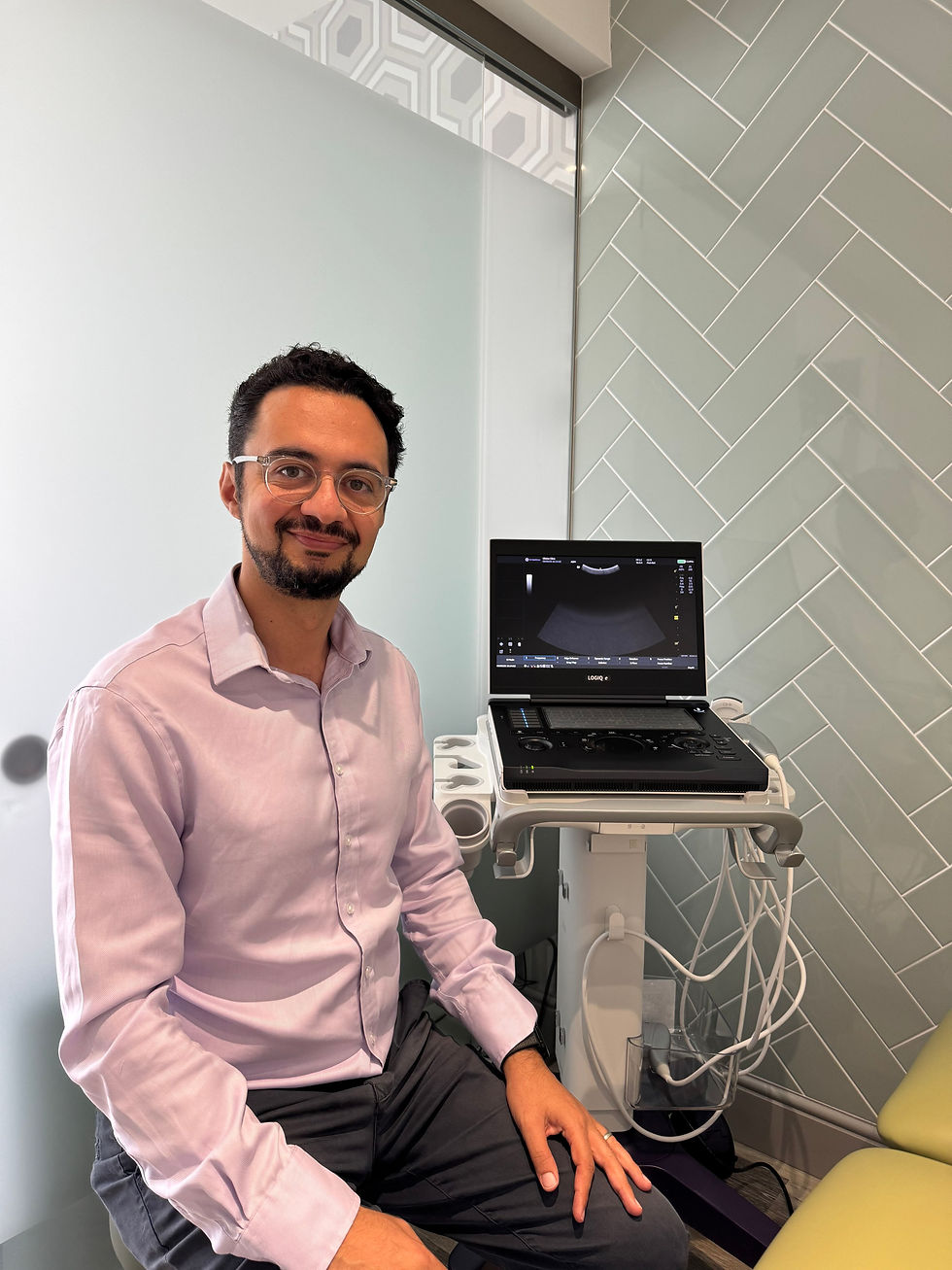
The Bottom Line: Point-of-Care Ultrasound (PoCUS) is a rapid, non-invasive bedside imaging tool that allows your doctor to look inside your body during a standard consultation. By April 2026, Olivine Clinic in Poundbury, Dorchester, will be offering advanced heart and lung ultrasound assessments. For our patients, this means receiving immediate, hospital-grade diagnostic answers without the wait, anxiety, or unnecessary trips to the hospital.
What is the FUSIC Heart and Lung Course?

In April 2026, I will be undergoing intensive clinical training at the highly regarded FUSIC (Focused Ultrasound for Intensive Care) Heart and Lung course, run by Bromley Emergency Courses in London. Fully approved by the Intensive Care Society, this rigorous program is traditionally designed for critical care doctors working in Intensive Care Units (ICUs) and Emergency Departments (A&E).
What does FUSIC cover? It trains physicians to use ultrasound to immediately assess the pumping function of the heart, inspect the cardiac valves, and evaluate the lungs for fluid build-up, infection, or collapsed segments.
Bringing these advanced, ICU-level skills into a Private GP setting in West Dorset means I can offer a level of clinical safety and diagnostic precision that is rarely accessible in standard primary care.
Why Point-of-Care Ultrasound (PoCUS) is a Game-Changer
Traditionally, General Practitioners rely heavily on a stethoscope, clinical history, and physical touch. While these are foundational skills, they have subjective limitations. PoCUS acts as a "visual stethoscope," providing objective, real-time data.
Saves Time: Instead of waiting weeks for an outpatient echocardiogram or a hospital chest X-ray, we can obtain critical answers during your 30-minute clinic consultation.
Reduces Unnecessary Referrals: Not every worrying symptom requires a stressful and time-consuming visit to A&E. PoCUS allows us to safely rule out life-threatening conditions on the spot.
Reduces Decision-Making Risk: Critical data is obtained instantly. We no longer have to rely solely on clinical guesswork to determine if shortness of breath is a lung issue or a heart issue; we can literally see the root cause.
Saves Lives: In genuine medical emergencies, identifying a dangerous fluid build-up or a failing heart early ensures you are directed to the right specialist immediately, bypassing standard triage delays.
Real-World Examples: How PoCUS Changes Patient Management Instantly
To understand the transformative power of having a Private GP trained in FUSIC Heart and Lung, consider these three clinical scenarios where bedside ultrasound instantly alters the course of treatment.
Example 1: Decoding Severe Breathlessness (Heart Failure vs. Lung Disease)
The Scenario: An older patient arrives struggling to breathe. The critical question: Is this an exacerbation of a lung condition like COPD or Asthma, or is their heart failing to pump effectively, causing fluid to back up into the lungs (pulmonary oedema)? The Old Way: The GP listens to the chest. It sounds "crackly," but a wheeze is also present. Relying purely on audio, the GP might trial inhalers or send the patient to A&E if the distress is severe. The PoCUS Way: I place the ultrasound probe on the patient's chest. Within 60 seconds, I look for "B-lines"—bright, vertical, laser-like beams on the screen that clearly indicate fluid trapped in the lung tissue. Recent 2026 medical data highlights that a GP using PoCUS can increase diagnostic accuracy for heart failure to nearly 90%, compared to just 38% using standard clinical judgment alone. The Outcome: If I see B-lines combined with a weakened heart muscle, I instantly prescribe diuretics (water tablets) and arrange a rapid cardiology referral. If the lungs are completely dry, I confidently treat the respiratory condition. We bypass unnecessary hospital admissions and start life-saving, targeted treatment immediately.
Example 2: Detecting "Silent" Fluid Around the Lungs (Pleural Effusion)
The Scenario: A patient recovering from a recent chest infection still feels unusually breathless and complains of a dull, heavy ache in their lower ribs. The Old Way: A stethoscope might reveal slightly reduced breath sounds at the base of the lungs, but confirming the presence of fluid requires a referral for a hospital chest X-ray, which can delay diagnosis by days. The PoCUS Way: Using the FUSIC lung protocol, I scan the base of the chest cavity. Ultrasound is actually far more sensitive than a standard X-ray for detecting small volumes of fluid (a pleural effusion). The Outcome: If I spot a pocket of fluid, I can immediately measure its size and arrange for the patient to be seen by an acute medical team for drainage. This drastically cuts down their period of discomfort and accelerates their recovery.
Example 3: Assessing Hydration and Blood Volume (The IVC Check)
The Scenario: A patient presents feeling dizzy, weak, and with a rapid heart rate. Are they severely dehydrated (hypovoloemic), or is there an underlying cardiac issue causing the symptoms? The Old Way: We check blood pressure, assess the moisture of the tongue, and test skin elasticity—all of which are subjective and sometimes unreliable metrics. The PoCUS Way: I scan the Inferior Vena Cava (IVC), the large vein carrying blood back into the heart. If the vein is completely flat and collapsing with every breath, the patient is severely dehydrated. If the vein is bulging and rigidly fixed, the heart is struggling to pump fluid forward. The Outcome: This rapid "empty vs. full" visual assessment allows me to safely advise aggressive oral rehydration at home, or conversely, immediately alter blood pressure medications and fast-track a cardiology referral.
Your Private GP in Poundbury, Dorchester
At Olivine Clinic, our core philosophy is to provide proactive, precision medicine. By integrating my FUSIC Heart and Lung training into our daily practice, we are bridging the gap between traditional primary care and advanced, hospital-level diagnostics for our community in West Dorset.
Next Steps
If you are experiencing unexplained breathlessness, chronic fatigue, or simply desire a comprehensive, unhurried health assessment that utilises the latest in medical technology, I am here to help.
Book your consultation with Dr. Mehrdad Bordbar today:
Location: Olivine Clinic, 5 Hamslade Green, Poundbury, Dorchester, DT1 3DP
Action: Contact our clinic to schedule your comprehensive appointment. or read more about our philosophy and approach to Private GP appointments here.
Medical Reviewer: Dr. Mehrdad Bordbar BMBS MMedSc MRCGP AFMCP Date of Review: March 21, 2026 Citations: > 1. Frontiers in Medicine (2026). "Point-of-care ultrasound improves the diagnosis of heart failure in patients with dyspnea in primary care." 2. Point-of-Care Ultrasound Certification Academy (2026). "Scope of Cardiac POCUS in Primary Care." Professional Disclaimer: The information provided in this article is for educational purposes only and does not substitute for professional medical advice, diagnosis, or treatment. Always consult with a qualified healthcare provider regarding any medical condition.


Comments