
Worried About a Lump? Why PoCUS is Game-Changing for Your Private GP Assessment in Dorchester

Medical Review: Dr. Mehrdad Bordbar BMBS MMedSc MRCGP AFMCP
Last Updated: April 11, 2026
Disclaimer: This article is for informational purposes and does not substitute professional medical advice. If you have discovered a new or changing lump, please consult a healthcare professional immediately.
Finding an unexpected lump or bump on your body can be an immediate source of anxiety. Whether it is a small nodule on the wrist, a soft swelling in the groin, or a firm mass on the neck, the internal monologue usually jumps to the same question: Is this serious?
Traditionally, the first step in a medical assessment involved a "wait and see" approach or a physical examination based solely on touch. However, at Olivine Clinic in Poundbury, we have moved beyond these limitations. By integrating Point-of-Care Ultrasound (PoCUS) directly into our Private GP consultations, we provide instant, high-definition visualisation of what lies beneath the skin.
The Bottom Line: What is PoCUS?
Point-of-Care Ultrasound (PoCUS) is a diagnostic technique where your GP uses a portable ultrasound device during your appointment to look inside the body in real-time. Unlike traditional hospital scans that require separate referrals and weeks of waiting, PoCUS allows for an immediate transition from physical examination to internal imaging, offering rapid reassurance or directed clinical action.
The Evolution of Lump Assessment: Feeling vs. Seeing
For decades, the standard of care in General Practice for soft tissue lumps was palpation—the process of using the fingers to feel the size, shape, and consistency of a mass.
The Traditional Approach (Palpation)
While an experienced GP can gather significant information through touch, palpation is inherently subjective. Factors such as the depth of the lump, the patient’s body mass index (BMI), and the presence of inflammation can obscure the true nature of a swelling. Historically, if a GP was uncertain, the patient was referred to a hospital radiology department—a process that involves:
A GP referral letter.
Administrative processing time.
A wait of several weeks for an appointment.
A separate visit to a hospital or imaging centre.
Another wait for the results to be sent back to the GP.
The Modern Approach (PoCUS)

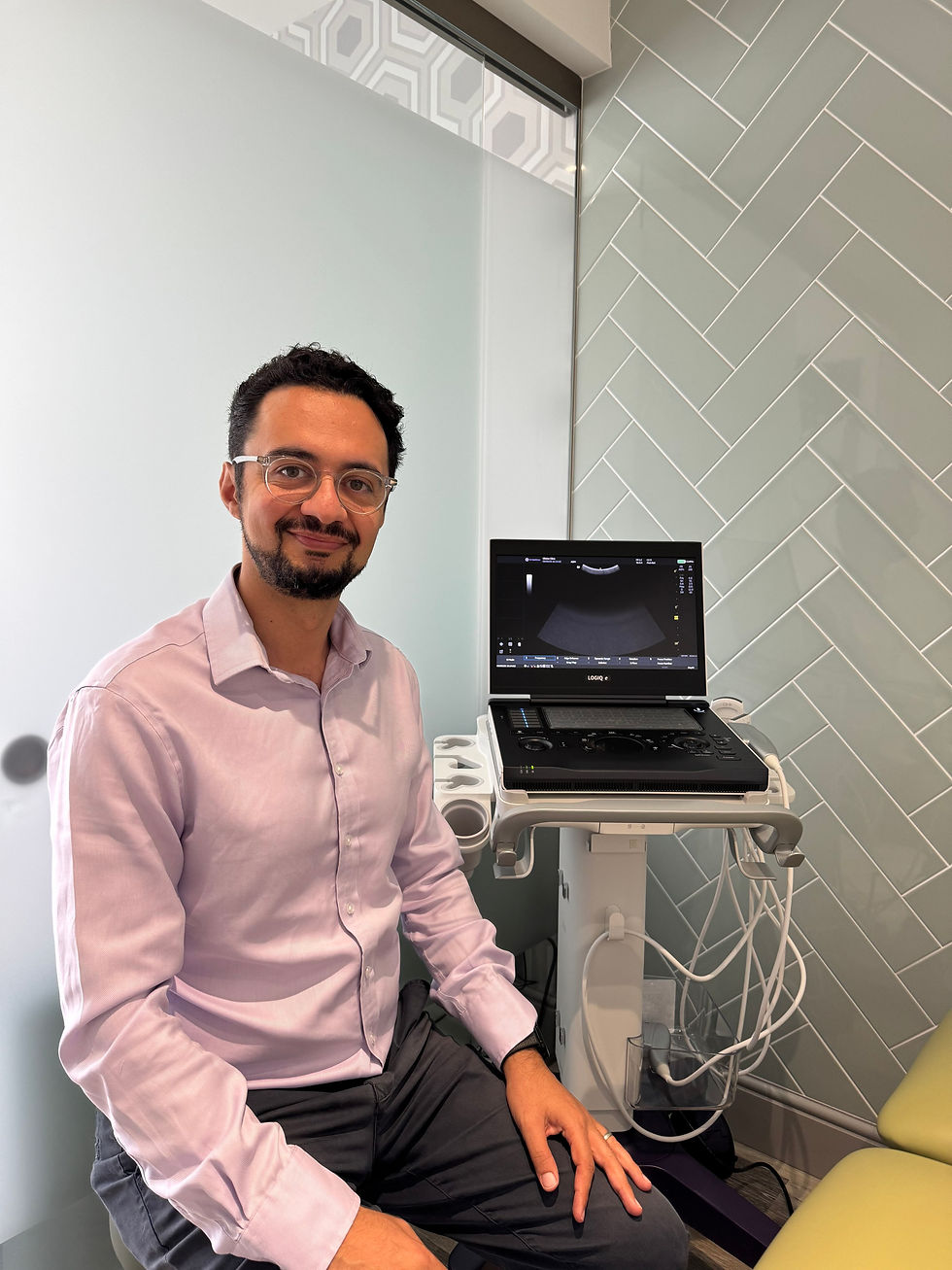
At our private practice in Poundbury, Dorchester, we eliminate these hurdles. During your consultation, Dr. Mehrdad Bordbar can utilise PoCUS to gain "visual palpation."
By applying a specialised probe to the area of concern, we can see the internal architecture of the lump. We can determine if it is fluid-filled (a cyst), solid (a tumour), or vascular (containing blood vessels). This immediate "inside look" provides a level of diagnostic certainty that touch alone simply cannot match.
Understanding the Nature of Lumps:
Common Diagnoses
Most lumps encountered in General Practice are benign (non-cancerous). However, knowing exactly what they are is essential for peace of mind and proper management.
1. Lipomas
These are slow-growing, fatty masses that often sit between the skin and the underlying muscle layer. They feel doughy and move easily with slight finger pressure. On an ultrasound, a lipoma has a characteristic appearance that distinguishes it from more concerning solid masses.
2. Sebaceous and Epidermoid Cysts
These are fluid or semi-solid-filled sacs. They are often associated with hair follicles or oil glands. PoCUS can easily identify the cyst wall and the nature of the fluid inside, helping to determine if it needs drainage or surgical excision.
3. Ganglion Cysts
Commonly found near joints or tendons (especially the wrist), these are filled with a jelly-like synovial fluid. PoCUS is excellent for mapping the "stalk" of the ganglion to see exactly where it originates.
4. Abscesses and Inflammation
If a lump is painful, red, and hot, it may be an abscess (a collection of pus). Ultrasound helps the GP see the depth and size of the infection, which is crucial if the lump requires a procedure called "Incision and Drainage."
Rare Causes and Red Flags: When to Act Quickly
While most lumps are harmless, certain "red flag" symptoms require urgent investigation to rule out malignancies such as sarcoma (cancer of the connective tissues) or lymphoma (cancer of the lymphatic system).
Clinical Red Flags for Lumps:
According to NICE (National Institute for Health and Care Excellence) guidelines, a lump is considered suspicious if it:
Is increasing in size: Especially if it is growing rapidly.
Is larger than 5cm: (Roughly the size of a golf ball).
Is deep-seated: Fixed to the underlying muscle or bone rather than moving freely under the skin.
Is painless but firm: Paradoxically, many cancerous lumps do not cause pain in their early stages.
Is associated with systemic symptoms: Such as unexplained weight loss, night sweats, or persistent fatigue.
How PoCUS Helps with Red Flags
If a lump shows high vascularity (significant blood flow) or irregular borders on PoCUS, it allows us to fast-track the patient into the appropriate NHS Two-Week Wait (2WW) pathway or private specialist care immediately. The ability to distinguish between a harmless fatty lump and a potentially "atypical" mass within minutes can literally be life-saving.
Why Prompt Assessment is Essential
The psychology of "finding a lump" is often dominated by fear, which can lead to medical avoidance. Patients may delay booking an appointment because they are afraid of the diagnosis or the perceived complexity of the testing process.
However, early diagnosis is the cornerstone of modern medicine.
Peace of Mind: For the vast majority of patients, PoCUS provides instant reassurance that the lump is benign, ending weeks of unnecessary stress.
Better Outcomes: If a lump does turn out to be serious, early intervention significantly improves the success rate of treatments.
Accurate Monitoring: If we choose to "monitor" a lump, having an initial ultrasound image provides a baseline. We can then re-scan in six months to see if there has been even a millimeter of change.
The Olivine Clinic Advantage: Saving Time, Worry, and Money
At Olivine Clinic, we believe that premium private healthcare should be efficient and transparent. The integration of PoCUS into our standard lump assessment protocol offers several distinct advantages for our patients in Dorchester and West Dorset.
1. No Hidden Costs
In most private hospitals or clinics, an ultrasound scan is a separate "diagnostic" fee. These scans typically cost between £350 and £550, in addition to the initial consultation fee with the doctor.
At Olivine Clinic, PoCUS scanning fees for lumps are included within your consultation fee. There are no surprise bills and no extra charges for the use of the ultrasound during your assessment.
2. No Referral Needed
In the traditional model, you cannot get a scan without a doctor's referral. By choosing a Private GP who is trained in PoCUS, you bypass the middleman. The person listening to your history is the same person performing the scan and explaining the results.
3. Immediate Results
The most difficult part of any medical investigation is the "waiting period." By providing an immediate scan, we eliminate the days or weeks spent wondering about the results. You walk out of the clinic with a clear understanding of the next steps.
What to Expect During Your Consultation
When you visit Dr. Mehrdad Bordbar at our clinic in Hamslade Green, Poundbury, your appointment will follow a thorough, patient-centred process:
Clinical History: We discuss when you first noticed the lump, any changes in size, and your general health history.
Physical Examination: A traditional palpation to assess the surface characteristics of the mass.
PoCUS Scan: A small amount of water-based gel is applied to the skin, and the ultrasound probe is used to visualise the internal structure. You can often see the screen alongside the doctor as he explains what is being observed.
Management Plan: Whether it is a "watchful waiting" approach, an on-site minor procedure, or a referral to a specialist, you will have a definitive plan before you leave.
Conclusion: Don't Wait and Worry
A lump should never be ignored, but it also shouldn't be a source of prolonged dread. With the advent of Point-of-Care Ultrasound, the "old approach" of feeling and guessing is a thing of the past.
As your Private GP in Dorchester, Olivine Clinic provides the technology and expertise to give you answers on the spot. By including ultrasound as a standard part of our assessment, we ensure that your path to clarity is fast, affordable, and accurate.
Next Steps: Take Action Today
If you have discovered a lump or have a "bump" that has been bothering you, don't wait for a long hospital queue. Experience the clarity of a PoCUS-guided assessment.
References & Evidence-Based Guidelines:
NICE Guidelines: Suspected cancer: recognition and referral (NG12) - https://www.nice.org.uk/guidance/ng12
NHS England: Soft Tissue Sarcoma Overview - https://www.nhs.uk/conditions/soft-tissue-sarcoma/
Royal College of General Practitioners (RCGP): The role of Ultrasound in Primary Care.


Comments